Tuesday, March 11, 2014

A Healthy Respect


My favorite long-time, regular reader and commenter of this blog, Anonymous, asked me in the comments of my last post: "Have you thought about doing any posts on microwave cooking?"

Not really, but you just gave me an idea.

Instead of taking my typical approach to blogging - doing research, finding linkages to bolster my contentions, and carefully crafting an argument, I'm approaching this one from a completely different angle for once.

Yeah, a number of years ago, I did some research on how the microwave oven is bad for human health. It's been a long time, but let me see if I can recall the things I've read about microwave oven cooking, and why I decided to stop using it for anything other than heating water for non-consumptive purposes - I don't even use it for defrosting frozen foods.

Microwaves destroy nutrients and minerals in food and water, they can also emit potentially toxic radiation while cooking, they alter protein molecules and destroy any natural pro-biotic bacteria present in your food. Regularly eating microwaved food is also linked to heartburn, acid reflux, indigestion, diarrhea and other digestive issues. Also, if you microwave anything with plastic wrap or Styrofoam containers, toxic compounds like bisphenol-A and other substances in the containers can leach into the food.

Here was one of the more memorable experiments I came across on teh Interwebz, from a high school kids science fair project:
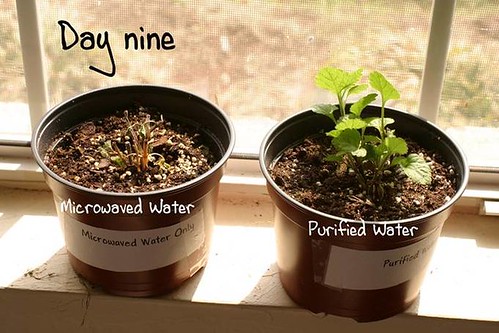
Update: This pic has purportedly been debunked - I still 'aint cooking with a microwave.


If the microwave devitalizes and denatures water, imagine what it's doing to your food...but I digress. Anyone can google all this stuff for yourself and find hours of reading on the topic.

On the other hand, I have a much more compelling reason to eschew this nutrient destroying tool of convenience: texture and taste.

Here's the one mention I previously made here about microwaving food:

In all this time, I've come to realize something else when it concerns eating food. It's not just the ingredients that I'm vigilant about.


I've also become really conscious of the habitual behaviors and social rituals around food.

Where I once considered cooking a laborious and time consuming chore (hence the rationalization for eating fast food 5 or more times a week), I now take great pride in procuring fresh, pure and natural ingredients, and taking great care to cook meals with said ingredients.

I despise the culture of the microwave. 

Wrapped in plastic and nuked, destroying the texture and full flavors of the ingredients.

I loathe the mentality behind driving and eating.

Or doing anything else BUT savoring well made food at a sit down meal.

I hate eating off of paper plates, paper napkins, Styrofoam cups and bowls, and with plastic utensils. I strive to make every meal I eat, a REAL MEAL, made with real food, eaten at table with real silverware and porcelain and glass flatware, with good company to commiserate and savor the meal with. It is one of the finest pleasures in this life.

All my friends and family are aware of my aversion to the microwave. When people offer me leftovers, I tell them I'd prefer to eat it cold from the fridge than having it zapped. I used to be the sort of person that couldn't bare to eat cold left overs. I always nuked my leftovers to get the food hot. Once I quit using the microwave, I figured out that most foods actually don't taste bad at all eaten cold....but I still prefer cooked foods, served hot. Nowadays, I usually take the extra step of reheating food the old fashioned way.

And in doing so, I also discovered something else, dishes like stews, chili's and soups that have all the fat congeal at the top of the dish in the refrigerator? They typically taste better on the re-heat than when they were freshly cooked and still piping hot! Something about refrigeration and reheating makes the flavors blend better.

Of course, a lot of folks will skim all that hardened fat out and dump it before reheating their food. Ugh. That's where all the flavor and nutrition is! Why would you take the best part of the food out and throw it away?

I've hosted dinner parties in which I've cooked a big pot of beef stew two days prior, chilled it for 24 hours, than reheated it just prior to guests arriving to eat. No one ever suspected they were getting "reheated leftovers" at my dinner table, but the compliments are always forthcoming, and I'm often asked what my "secret" is.

People seem to have bought into this notion that the microwave really saves them a lot of time and effort. But if you really do a comparison, you are literally sacrificing the taste, texture and nutritional value of your food to save perhaps 5 or 10 minutes of your time, at best. 

About the best argument you could make is that you're using less dishes to reheat your food. 

Whoop-de-doo. So instead of having to wash one microwavable Tupperware dish and a fork, I end up having to wash one Tupperware dish that I had refrigerated my food in, a plate, a fork and a pot or pan.So there's perhaps an extra 5 minutes on the clean up.

The way I spend time and money on procuring ingredients and cooking the food I and my family eat, I say it's worth the extra time spent to reheat a meal and have a little bit more clean up detail.

Healthy food deserves a healthy respect. I just don't find the taste and texture that gets altered by nuking your food in the microwave a worthy trade off to save the 10 or 15 minutes longer it takes to reheat and clean-up.

Leftover dinner food that takes 3 minutes to reheat, takes about 6-8 minutes on a stove top in a cast iron skillet, and the taste and texture is retained, if not improved from conventional reheating.

A bag of microwave popcorn takes 4-5 minutes. Issues of microwaveable popcorn ingredients aside, using a covered pot and some butter and macadamia nut oil, I can pop a full bowl of popcorn in about the same 5 minutes, and season it with real salt and spices, and it tastes and smells far better, too. 

The only thing is you have to actually stand over the pot and continuously shake it to keep the popped corn from burning.

But I guess the 5 minutes you would spend over the stove is not as valuable as 5 minutes watching the tell-a-vision or updating your facebook page from your smartphone, while the microwave is nuking your teflon-lined, paper bag full of kernels, partially-hydrogenated oils and artificial butter flavors.



In the past 5 years of exploring the topic of food and nutrition on teh Interwebz, I've developed a much better relationship and respect to my food that I put into my body.

Why would I purposely go through the care and effort of raising my own chickens and feeding them custom mixed feed to have a regular supply of nutrient-dense, free-range/pastured eggs...only to zap it and destroy all those nutrients I otherwise spent all that time and effort cultivating?

Why would I go out of my way on a weekly basis to travel to the Farmer's Market in my part of the island to procure freshly harvested organic produce so that I can saute them in high quality, grass fed butter and expensive macadamia nut oils...only to destroy all the vitamins and minerals in a radio active box for the sake of saving 5 minutes of time and effort?

Or the fresh fish or grass fed beef or the bone broth stocks and soups I usually make overnight in the crockpot?

Real food, takes real time to make and real time to enjoy. It is a labor of love. To cherish these principles, I don't find it difficult at all to eschew the so called time-saving convenience the microwave provides. As the old saying goes, you are what you eat, and I don't eat or drink anything that is nuked or zapped.

I respect my body, by respecting my food.


Post Script -After seeing some comments both here and over at RedPillWomen on this post (thanks for the linkage, Stingray), I realized this post was not as clear in my "anti-microwave your food" sentiment as I thought. My bad.

Zap your food for all I care. Anonymous just asked me to do a post on microwaves, so I put my thoughts down in a stream-of-conscious style blog post (which is not how I normally write when I put together a post here.)


To clarify - I did a lot of research on the topic 5+ years ago. Based on so much conflicting reports, I cannot say for certain that microwave ovens are truly bad for human health. But I can say it is certainly bad in affecting the texture and taste of the food you cook with it, and for me, that is enough of a reason for me to not use the damn contraption.

As I said before, I've developed a passion for cooking and eating quality, wholesome and nourishing foods in the past few years, and I see the microwave as an affront to those things.


Friday, March 7, 2014

Cold Turkey Lung Cancer


This is why THEY oppose smoking by we the sheeple.

TL;DR Synopsis: If you are a long time cigarette smoker of 20 or more years or you know someone who is, and you or the person you know is contemplating quitting, DO NOT QUIT COLD TURKEY. You are far more likely to experience sudden onset of fatal lung tumors, than if you taper off slowly! If you are already in your 70's and have been smoking your whole life, you probably shouldn't even try to quit at all.

Mandatory Disclaimer: The author of this site is not engaged in rendering professional advice or services to the individual reader. The ideas, procedures, and suggestions contained within this work are not intended as a substitute for consulting with your physician. All matters regarding your health require medical supervision. I shall not be liable or responsible for any loss or damage allegedly arising from any information or suggestions within this blog. You, as a reader of this website, are totally and completely responsible for your own health and healthcare.

 http://www.blogblog.com/scribe/divider.gif

I used to work for a man who smoked from the age of 13 until he died from lung cancer at 73. Probably most folks are related to or know of someone that had a similar story regarding smoking and lung cancer.

Everyone knows cigarettes cause lung cancer, right?

I am now of the opinion that this is only partially true.

See, the man I used to work for had gone to the Doctors after his 73rd birthday for a full body physical. As a life long, retired US Navy man, he had the full coverage and access to the entire medical services and health care provided by the Government. He had blood work, urinalysis, prostate exam, etc.

The Doctor was astounded that he was in such good health for a man his age. Paraphrasing what the Doctor told him after all the testing results were in: "You are in such great health, if you would only quit smoking, you might very well live to be 100!"

For the last 10 years or so, this man had switched to buying bulk organic, roll-your-own (RYO) tobacco, and smoked about 8-10 a day. He did have a smokers cough, but nothing too bad. He told me that once he had switched to the organic RYO, he no longer woke up every morning hacking and wheezing for 10 minutes or so just to clear out all the darkened mucus that accumulated in his respiratory system while he slept, like when he used to experience when he was a pack a day chain smoker of a popular Big Tobacco brand cigarette.

But inspired by the great health report from his Doctor, he finally decided it was time. He quit cold turkey.

One week later he went to the hospital with pneumonia. Chest X-rays were negative, he just had fluid in his lungs.

One week later, the hospital sent him home to recuperate after a round of antibiotics appeared to treat it and his lungs somewhat cleared up.

One week later he was back in the hospital with a "pneumonia relapse." This time, chest X-rays showed massive tumors in both lungs.

One week later, he was dead.

I did not understand how a man given a total clean bill of health just a month or two prior, could suddenly develop lung cancer so fast.

So I do like I always do when I encounter an enigma that bothers me during sleepless bouts of insomnia, staring at my ceiling and contemplating such thoughts...I started googling.

The following article is a fair representation of the types of articles I found on the first few pages of results - Spontaneous Smoking Cessation Before Lung Cancer Diagnosis

Introduction: We have observed that many patients with lung cancer stop smoking before diagnosis, usually before clinical symptoms, and often without difficulty. This led us to speculate that spontaneous smoking cessation may be a presenting symptom of lung cancer.

This is the general approach I found in numerous articles. Many lung cancer patients quit smoking cold turkey, without much problem (so much for tobacco being as addictive as heroin or crack cocaine...), and with no symptoms of lung cancer whatsoever before they decided to quit.

Conclusions: These results challenge the notion that patients with lung cancer usually quit smoking because of disease symptoms. The hypothesis that spontaneous smoking cessation may be a presenting symptom of lung cancer warrants further investigation.

In other words, it appears to be the consensus view of the Big Healthcare and Big Science researchers that the decision to quit smoking cold turkey is a symptom of the onset of lung cancer... that they seemed to "sense" they were about to develop cancer, so they intuitively quit cold turkey.

As always when it comes to discerning modern science reporting and peer reviewed publishing, the very first thing you must always look for is correlation versus causation. All these reports I read seemed to focus on abrupt smoking cessation as a correlated symptom.

After all, it's already accepted as scientific fact that long term smokers get lung cancer, right?

But then I found this article on the back pages of my google search that appeared to make the case that abrupt cessation may in fact be the causation of lung cancer!

The clinically high correlation between smoking and carcinoma of the lungs has been the focal
point in societal campaigns against the habit and the tobacco lobby. In an overview of per-
sonal history in a number of lung cancer patients locally, we are struck by the more than
casual relationship between the appearance of lung cancer and an abrupt and recent cessation
of the smoking habit in many, if not most cases.

The association is more than just casual-development of cancer within a few months of eschewing cigarette smoking. Over a period of 4 years, a total of 312 cases were treated for carcinoma of pulmonary origin: of this number, 182 patients had quit smoking within 5-15 months prior to their being diagnosed with lung cancer. Of the 182 patients 142 were male and 40 were females, with ages ranged between 47 and 74. Each one of had been addicted to the habit for no less than 25 years, smoking in excess of 20 sticks a day. The striking direct statistical correlation between cessation of smoking to the development of lung malignancies, more than 60% plus, is too glaring to be dismissed as coincidental.

It is our premise that a surge and spurt in re-activation of bodily healing and repair mechanisms of chronic smoke-damaged respiratory epithelia is induced and spurred by an abrupt discontinuation of habit, goes awry, triggering uncontrolled cell division and tumor genesis. In normal tissue healing, anabolic and catabolic processes achieve equilibrium approximately 6-8 weeks after the original insult. When an imbalance occurs between these phases occur in the healing process, disruptions in repair limitations occur leading to tumor genesis this sequence is best exemplified in the formation of keloids from scars.

Nicotine stimulates corticotrophin-releasing factor (CRF) besides increasing the level of adrenocorticotropic hormone (ACTH), both of which interfere with immune systems. Abrupt withdrawal of the addictive drug could trigger derangement of the ‘smoking-steroid’ conferred immunity, priming the healing lung epithelia to dangerous levels uncontrolled cell division.


I'm wondering if this man I used to work for had never listened to his Doctor and never quit smoking....or if he had simply weaned himself off slowly, would he still be alive today?


Perhaps. There are no guarantees in this life, other than the fact that we are all going to die someday.


Needless to say, I know what I think about this topic. If you've been smoking for a long time, and you decide to quit, there are a few things you should probably consider before you do so. Quitting smoking after habituating your body to regular dosing of it for a long period of time, is no doubt a major stress for even an otherwise healthy body to handle. Abrupt cessation after decades of usage is undoubtedly a shock to the body, and one who decides they need to quit, should make sure they are in otherwise good health, not trying to recover or repair from some other major health event or condition, and to slowly taper down over a long period of time.


But if you're like Beatrice Langely, the lady pictured at the top of this post who started smoking at 8 years of age, and you're still puffing away on your 100 birthday, at this point it would be pointless and needlessly stressful to try and quit. If it 'aint broke, don't fix it. If you're one of those who is living a paradoxical life of longevity as a smoker, you may as well stick with your "habit" until the very end.

What do you want to bet Beatrice Langley has outlived a Doctor or two that got after her to quit smoking over the past 90+ years?

Friday, February 28, 2014

No Leaf Clover


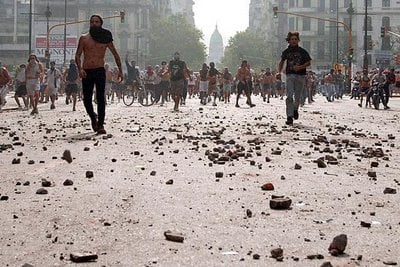
Post-Economic Collapse, Argentina 2001


"And it comes be that the soothing light at the end of your tunnel....is just a freight train coming your way."

I've seen a lot of naysayers and offhand critiques deriding the MAndrosphere for "fantasizing about the collapse" or calling it "Doomsday Porn." Many folks have made statements claiming they can't wait for it to all come crashing down, so the rebuilding can begin.

It seems we have a dichotomy of generalized opinion on a potential economic collapse of Western society going on...those who can't wait because they are confident in their abilities to survive societal upheaval, versus those who believe it can never happen, or that it might happen, but even if it did, there is nothing we can do, so live and let live, whatever may come, will. I don't adhere to either viewpoint....since I'm a conspiracy-theory realist and cynic, I already know the collapse is coming, it is deliberately engineered, and it will be accomplished to achieve an abominable and inhumane agenda - total population control.

This viewpoint is considered crazy, delusional and paranoid. I'm fine with that.

Just call me Cassandra.

My only answer is to say open up your eyes and LOOK.

How can you not see that our current society is unsustainable? We are a society that is perpetually taking on new debt to simply service the debt we already have.

$15,064,816,000,000- The U.S. GDP in 2011. The debt as of Jan 1st, 2012 is 15,170,600,000,000. United States now owes more money than its yearly production (GDP).

We cannot keep up this charade in perpetuity. The bill always come due, and perpetual debt-spending by a Government to keep the lights on eventually results in bankruptcy and the lights getting cut off.

Thanks to immersing myself in the Shit-Hits-The-Fan-Prepper-Sphere, I discovered a slew of first hand accounts of what an economic collapse in a modern country looks like - Argentina in 2001.

In 2001, I was a daily reader of both national and local newspapers and periodicals, as well as a daily watcher of Tell-A-Vision "news." I don't recall any reporting whatsoever about Argentina's economic collapse and subsequent descent to third-world, hellhole conditions. Of course, we had other world changing events that dominated the headlines back then...

Anyhow, looking at what happened in a formerly prosperous, "first world" society, the parallels we are seeing in the rest of the "first world" to the events leading up to the Argentinian collapse of 2001 are foreboding.

You think it can't happen here? Think again.

 One man's account describes it like this:

“How can I prepare for an economic collapse?” is one of the most common questions I get. It usually takes me a second to start to explain how complex such a question is. It’s like asking an auto mechanic, “Say, how do you build a car?” or asking a computer engineer, “What’s all that stuff inside my laptop?”

I do have some first-hand experience in this matter, though. The economy in my country, Argentina, has gone through various crises, but none as large as when the economy collapsed in 2001 after a decade of apparent prosperity. The currency devaluated, and Argentina defaulted on its USD$132 billion debt, the largest default ever. The middle class took to the streets after bank accounts were frozen, and the president was forced to resign, escaping the presidential building in a helicopter.

That's all it takes to get the catastrophe ball rolling.

The Government simply declares a default, the banks freeze all accounts, and the basic necessities of living that everyone has become dependent on acquiring from our Just-In-Time distribution Supermarket and Big Chain Retail suddenly start doubling and tripling prices as panic hoarding kicks in and the shelves are emptied in a matter of hours.


In my lifetime, I've seen the store shelves here in Hawaii get emptied several times...two hurricanes, a pending tsunami and an earthquake all kicked off a frenzy of grocery hoarding and mile long lines at gas stations. In all of those instances, order was restored and "normalcy" of our current corporatist consumer-driven society resumed in a matter of days.

But when (not IF, but WHEN, as a default is coming. It is inescapable. Maybe tomorrow, maybe 10 years from now...but make no mistake, it's coming,) USA Inc. defaults, the dollar crashes, the bank accounts of the masses get frozen and the grocery and hardware stores get emptied, the "return to normalcy" is not happening.

It's going to be much worse in the US than what happened in Argentina.

For the Argentinians, the freezing of bank accounts instantaneously cast the entire middle class into poverty.

In the USA Inc., this will be terrible...but we also have a large poverty class living a virtual, debt-driven "middle class" consumption lifestyle, financed by the entitlement-dependency programs of the Federal Government. We are at a new record of dependence here: New record: 15 percent of Americans on food stamps


When the bank accounts get frozen, and at the same time all the EBT cards that are now feeding 15% of the nation no longer work, The Shit is Going to Hit the Fan and it will be the End of the World as We Know It.

Are you prepared for this? No? It's still not too late...

 http://www.blogblog.com/scribe/divider.gif

Take the advice of people who have been there and done that.

Here's a condensed version of some excerpts  taken from the SHTFplan blog:

Step #1: Acquiring precious metals (I generally recommend 20% of your savings but each person is a separate case) and a month’s worth of expenses in cash, kept safe at home.
Every single Argentine wishes he could go back in time, close his bank account, and put that money into gold. We would all do that if we had a time machine. Since you can’t guess the future, all you can do is estimate what can happen and play the odds in your favor. In the event of a full economic collapse, if you have 20% of your savings in physical gold and silver, that’s a percentage of your savings that is spared. It’s not an investment; don’t go crazy over gold and silver going up or down a few dollars, just be content that it’s not getting any lighter as it sits in your safe. If the economy collapses or even if there’s simply inflation (as there clearly will be), that percentage of your savings in precious metals is safe and will likely go up in price beyond its standard purchasing power as things get worse.


During the first stages of a severe economic crisis, you will see ATMs running out of money fast, and many stores won’t be accepting credit cards. {and EBT-SNAP cards too.}

As the saying goes, “Cash is king” during those times. Your precious metal can be sold to a dealer, but you better keep that stored for now. When everyone is running around looking for an ATM with a few bucks in it, having a month’s worth of expenses in cash means you won’t be one of them. Why not more than a month´s worth of expenses? Because if the economy fully collapses, that paper money will lose its value within hours. It may drop 50%, 60%, or 75%, as happened in Argentina. Who knows? All you know is that as the currency loses value, the value of the precious metals you have stored goes up in proportion. Still, during those first days, a wad of cash gets you what you need.


Step #2: Stock up on food.
The more you have, the better. There may be periods of civil unrest like the ones we saw where stores are being looted and closed after that. There may be problems with resupply because of logistical complications. It’s better if you already have 6 to 12 months worth of food in your expanded pantry. Also, keep in mind the food you buy now will be considerably cheaper compared to post-inflation prices.


Step #3: Acquire the essentials by putting together a survival/emergency kit.
This will include your typical camping gear: a tent, sleeping bags, a stove (have enough fuel for it in case services are disrupted), first aid kit, medicines, LED flashlights and several spare batteries. Depending on how bad civil unrest gets, there may be problems with the infrastructure. After the economy collapsed in Argentina, the power company simply couldn’t afford the repairs needed, and it hadn’t planned for something like this, either. Rolling blackouts became common, and having LED lights and rechargeable batteries was a blessing. You could easily spend two or three days without power during summer. {Worse for North Americans...power outtages during Winter could be fatal rather than simply uncomfortable in the southern hemisphere's summer heat.}


Step #4: Improve your personal and home security.
During the first days after the economy collapsed, civil unrest, rioting and looting was out of control. A state of siege and military law was declared, enforcing curfew hours after 10 pm. This lasted a few months, and for months after that, while order was recovered in the capitol district, there were still occasional revolts and looting. The sense of lawlessness extended way beyond the visible accounts depicted by the TV and general media.

It’s during times like these that you realize you must have means of defending yourself and your family. My advice is to make your home as secure as possible against criminals that may take advantage of the lack of control during the worst of the rioting. After that, a better security plan for the entire family must be worked out. As things get worse, you understand that you can no longer afford to be lax about your personal and home security. Those that are quickly become vicitims. With a more secure home, you may want to consider having a weapon to defend yourself. Certainly not an easy decision, and one you must be extremely serious about. If you have the self-control and maturity to handle one, having a firearm and getting the minimum training to know how to use (it if it ever comes to that) is something you should consider doing.

Crime and insecurity will be one of the greatest threats people all across USA will suffer, and very few will be ready for it. It won’t happen one dark gloomy night after watching the latest horror movie. It will happen in the Walmart parking lot at 3 pm, with plenty of people around (people who will hurry out of the way, pretending not to see anything). You’ll be thinking about what you just bought, that you maybe should have bought Lucky Charms instead of Corn Flakes. That’s when the nice-looking person with two other buddies, all well-dressed (with neat hair cuts, too), pulls a gun on you. Developing a sense of awareness will be the most important part, as well as making the rest of your family comprehend that times have changed and you can no longer be careless regarding security.


Step #5: Embrace a different mindset.
When Argentina went through its economic collapse, people handled it differently. Maybe the most common response was denial. The “I can’t believe this is happening “ attitude was pretty popular. Others complained, but you soon understood it changed nothing: It only made you feel more miserable, more stressed, and that was something you could do without. Others just ended their misery. Suicide rates doubled after the collapse, with people sometimes jumping under the train at early rush hour in a desperate attempt to make their misery noticed by others.

What you need to do is become more positive, more active. Be someone who, while accepting those things you can’t change, does something about the things you can. Get involved now, do what I just recommended right now, it will bring you peace of mind. Remember to stay positive and put every problem into perspective. Complain less. You’ll have enough to complain about when inflation gets worse. Soon you’ll understand that material things can be replaced, and you become more grateful for what you have instead of worrying about what you don’t.

It’s essential to keep a positive attitude. Being someone that gets easily depressed will be the end of you as the economy worsens. Problems much worse that what you are used to will be a daily occurrence. You’ll just have to roll with it and learn to cope with the new world you live in. Reinforce your relationships with people. Fight stress by finding a hobby you enjoy, hopefully one that has a practical side as well. After the collapse, lots of people started their own businesses when they realized there were no jobs to be found. It would be better if you get started now, just in case you ever need it in order to earn a living.

These are my recommendations. I know many people could have used such advice back when our economy collapsed. - Fernando “FerFAL” Aguirre at TheModernSurvivalist.com

 http://www.blogblog.com/scribe/divider.gif

 There are some fundamental differences between the state of the USA Inc. and Argentina in 2000-2001, just prior to their economic collapse.

We probably have the most heavily armed populace the world has ever seen. When the SHTF, it's going to be a total warzone once fighting over the basics of survival commences. I have family members who are staunchly "anti-gun" and are utterly opposed to anyone owning guns. They always vote for gun control politicians, and always challenge and question my beliefs and ownership of numerous weapons.

Yet they have food storage and are preparing for possible societal catastrophe (not because they believe as I do, but rather due to past experiences with hurricane preparedness). When I tell them they are just creating storehouses for the looters with guns to come and take it from them when the SHTF, they act like they don't even hear what I'm saying. It's cognitive dissonance at it's worst. Don't let your political ideology get in the way of your preparedness. You think the cops are minutes away from saving you NOW, imagine what it will be like when the cops are in the midst of society wide rioting and unrest?

There will be no one coming to save you.

Ask the Korean C-Store owners in L.A. in 1992 about that.


I also believe the huge segments of our populace that are dependent on Federal Government entitlements to get their daily food are also the sort of people who will in a matter of hours begin looting, rioting, robbery and other such predations on people who may have food stores and other material consumables when the banks freeze, the EBT cards stop working, and the store shelves are emptied.

They already have an entitlement mindset, as well as a healthy sense of envy and covetousness of those in the upper economic classes....and in America, they are already well armed, or one household burglary away from getting heavily armed.

Don't be sheep waiting for the ravening wolves to come to devour you and your family when the time comes and law and order disappears in moments.

Get armed, get trained, and be ready. The financial apocalypse of the greatest economy the world has ever seen is inevitable, and most likely destined to happen within our lifetimes - and probably sooner rather than later.