Friday, January 14, 2011

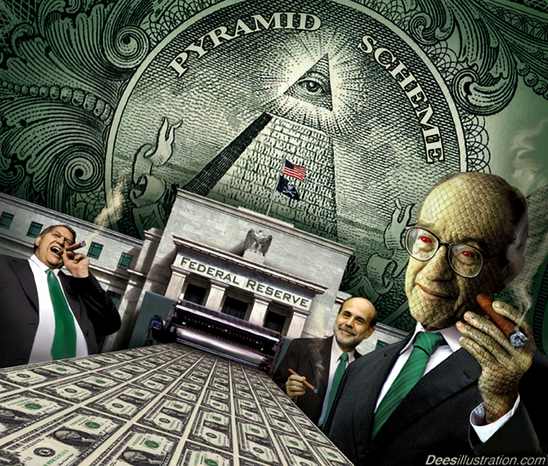
What if the Federal Reserve System Had Not Been Created?


I came across an interesting article from the economic collapse blog, entitled 10 Things That Would Be Different If The Federal Reserve Had Never Been Created.

Here are some salient points from the article I'd like to highlight, followed by all 10 things that would be different:

Many of those opposed to the Federal Reserve will point to the record $80.9 billion in profits that the Federal Reserve made last year as evidence that they are robbing the American people blind. But then those defending the Federal Reserve will point out that the Fed returned $78.4 billion to the U.S. Treasury. As a result, the Fed only made a couple billion dollars last year. Pretty harmless, eh? Well, actually no. You see, the money that the Federal Reserve directly makes is not the issue. Rather, the "magic" of the Federal Reserve system is that it took the power of money creation away from the U.S. government and gave it to the bankers.

This is the key point...and it was not just to the highest level bankers either. What the Federal Reserve did was institute the system of fiat currency combined with fractional reserve banking which gave the power of money creation to ALL bankers in the Federal Reserve system - hence the criticisms calling it the money creating cartel. From your locally owned bank specific to your community to the big national banks...if they are "FDIC insured" they are a member of the cartel, and they too participate in "creating" money by entering figures into their accounting software with a few keystrokes, creating a debt for which the bankers profit from the interest. This is one of the primary drivers of inflation.

But it's worse than that.

Now, the only way that the U.S. government can inject more money into the economy is by going into more debt. But when new government debt is created, the amount of money to pay the interest on that debt is not also created. In this way, it was intended by the international bankers that U.S. government debt would expand indefinitely and the U.S. money supply would also expand indefinitely.

In theory, the Government could simply abide by the Constitution and begin issuing currency again without paying interest to the Federal Reserve...

...but anytime former Presidents tried to do that, they ended up getting assassinated. Lincoln issued Greenbacks, JFK issued silver certificates. Both had their brains blown out. Coincidence? Perhaps.

Many liberals won't listen because they don't really care about ever paying off the debt, and most conservatives won't listen because they are convinced we can solve the national debt problem if we just get a bunch of "good conservatives" into positions of power, but the truth is that we have such a horrific debt problem because it was designed to be this way from the beginning.

So how would America be different if we could go back to 1913 and keep the Federal Reserve Act from ever being passed? Well, the following are 10 things that would be different if the Federal Reserve had never been created....

#1 If the U.S. government had been issuing debt-free money all this time, the U.S. government could conceivably have a national debt of zero dollars. Instead, we currently have a national debt that is over 14 trillion dollars.

#2 If the U.S. government had been issuing debt-free money all this time, the U.S. government would likely not be spending one penny on interest payments. Instead, the U.S. government spent over 413 billion dollars on interest on the national debt during fiscal 2010. This is money that belonged to U.S. taxpayers that was transferred to the U.S. government which in turn was transferred to wealthy international bankers and other foreign governments. It is being projected that the U.S. government will be paying 900 billion dollars just in interest on the national debt by the year 2019.

#3 If the U.S. government could issue debt-free money, there would not even have to be a debate about raising "the debt ceiling", because such a debate would not even be necessary.

#4 If the U.S. government could issue debt-free money, it is conceivable that we would not even need the IRS. You doubt this? Well, the truth is that the United States did just fine for well over a hundred years without a national income tax. But about the same time the Federal Reserve was created a national income tax was instituted as well. The whole idea was that the wealth of the American people would be transferred to the U.S. government by force and then transferred into the hands of the ultra-wealthy in the form of interest payments.

#5 If the Federal Reserve did not exist, we would not be on the verge of national insolvency. The Congressional Budget Office is projecting that U.S. government debt held by the public will reach a staggering 716 percent of GDP by the year 2080. Remember when I used the term "debt spiral" earlier? Well, this is what a debt spiral looks like....

#6 If the Federal Reserve did not exist, the big Wall Street banks would not have such an overwhelming advantage. Most Americans simply have no idea that over the last several years the Federal Reserve has been giving gigantic piles of nearly interest-free money to the big Wall Street banks which they turned right around and started lending to the federal government at a much higher rate of return. I don't know about you, but if I was allowed to do that I could make a whole bunch of money very quickly. In fact, it has come out that the Federal Reserve made over $9 trillion in overnight loans to major banks, large financial institutions and other "friends" during the financial crisis of 2008 and 2009.

#7 If the Federal Reserve did not exist, it is theoretically conceivable that we would have an economy with little to no inflation. Of course that would greatly depend on the discipline of our government officials (which is not very great at this point), but the sad truth is that our current system is always going to produce inflation. In fact, the Federal Reserve system was originally designed to be inflationary. Just check out the inflation chart posted below. The U.S. never had ongoing problems with inflation before the Fed was created, but now it is just wildly out of control....

#8 If the Federal Reserve had never been created, the U.S. dollar would not be a dying currency. Since the Federal Reserve was created, the U.S. dollar has lost well over 95 percent of its purchasing power. By constantly inflating the currency, it transfers financial power away from those already holding the wealth (the American people) to those that are able to create more currency and more government debt. Back in 1913, the total U.S. national debt was just under 3 billion dollars. Today, the U.S. government is spending approximately 6.85 million dollars per minute, and the U.S. national debt is increasing by over 4 billion dollars per day.

#9 If the Federal Reserve did not exist, we would not have an unelected, unaccountable "fourth branch of government" running around that has gotten completely and totally out of control. Even some members of Congress are now openly complaining about how much power the Fed has. For example, Ron Paul told MSNBC last year that he believes that the Federal Reserve is now more powerful than Congress.....

"The regulations should be on the Federal Reserve. We should have transparency of the Federal Reserve. They can create trillions of dollars to bail out their friends, and we don’t even have any transparency of this. They’re more powerful than the Congress."

#10 If the Federal Reserve had never been created, the American people would be much more free. We would not be enslaved to this horrific national debt. Our politicians would not have to run around the globe begging people to lend us money. Representatives that we directly elect would be the ones setting national monetary policy. Our politicians would be much less under the influence of the international banking elite. We would not be at the mercy of the financial bubbles that the Fed has constantly been creating.

Ron Paul has got it right.

End the Fed.

Friday, January 7, 2011

Red Pills for Vegans


On the piece I did regarding veganism, I tried to point out that the history of veganism in the US was largely the efforts of Kellogs, the man who invented breakfast cereal. He was a seventh day adventist and his veganism was based on his faith...not the scientific facts of which diet is best suited for the human physiology.

Seems like in the vegan community, the faith is still pretty strong...even when there is scientific evidence that demonstrates just how mistaken certain vegans may be when it comes to the health effects of their chosen belief system.

The problem for many vegans, is that the most convincing arguments against veganism are now coming from ex-vegans, many of whom were dedicated vegans, until health problems associated with their diets made them reach the point of re-evaluation. Once they give up their vegan principles and begin to eat meat and other animal products, many experience a resurgence in good health.

People like Lierre Kieth, Rhys Southan and Melissa McEwen have put forth their personal stories and have been ridiculed, dismissed and even physically attacked by their former vegan compatriots. (Lierre Kieth was once assaulted by malicious vegans throwing hot pepper-laced pies into her face).

But the latest ex-vegan that has literally been destroying vegan arguments on the interwebs in 2010, is one, Denise Minger.

She's got the true believers utterly flummoxed..and for good reason.

She gained notoriety in the paleo/ex-vegan blogosphere when she turned her meticulous researcher's eye onto the research that has been considered the holy grail of veganism: Dr. Colin Campbell's The China Study.

While many others have pointed out that Campbell's conclusions were flawed because they were based on cherry picking the data from 7 countries -- when the stats were gathered from more than 20 -- to reach his subjective and pre-determined conclusion that veganism was the healthiest diet for humans, Denise actually waded through the research and went on to painstakingly show that Campbells support for veganism as the healthiest diet was based on far more deceptions and misrepresentations than simply just cherry picking his data.

You can see for yourself just how thoroughly she debunked Campbell's claims here.

Her initial case was so compelling, Campbell himself actually deigned to respond to her. She responded, and essentially cleaned his clock, causing he and his followers to cease trying to debate with her.

But her latest blog post goes even further, by taking on one of the biggest shibboleths promoted in our mainstream mass media culture today: the idea that meat and saturated fats clog the arteries and cause heart disease.

From Will Ditching Meat Save Your Arteries?


Sometimes, when I feel like I don’t have enough stress in my life and start craving a blood-pressure boost, I go to my old vegan haunts to read gems like these:


The only way meat can be digested is by putrefaction, our stomach acid is only 5% of that of a carnivore or omnivore so instead of being digested it basicly [sic] rots in your intestines which leaves toxic gases and waste to be absorbed into the blood.


we know what’s happening. we’ve known for decades. however, we also have found that when we talk about the health detriments associated with eating the products of the corpse industries, people don’t believe us.


[T]here is a single, sole cause to heart disease: cholesterol. If your total cholesterol is below 150 and LDL is below 70, you are essentially heart attack proof. What is the cause of high cholesterol? Saturated fat and animal products.

Don’t you love this stuff? But I digress. What I want to talk about right now is one of the most oft-cited perks of being a vegetarian: an apparently lower risk of heart disease compared to omnivores.

I remember when I used to believe all of those things steadfastly...and I wasn't even a vegan. I was more accurately a guilt-consumed meat eater that would go on vegetarian binges. I'd abstain from meat and dairy for days on end, because I believed those lies. And it certainly didn't make my health better for it.

Denise goes on:

A recent paper called Chemistry Behind Vegetarianism sums it up by saying “Omnivores have a significantly higher cluster of cardiovascular risk factors compared with vegetarians, including increased body mass index, waist to hip ratio, blood pressure, plasma total cholesterol (TC), triacylglycerol and LDL-C levels, serum lipoprotein(a) concentration, plasma factor VII activity, ratios of TC/HDL-C, LDL-C/HDL-C and TAG/HDL-C, and serum ferritin levels.”

This is a trend that some folks translate as “meat causes heart disease”—a sentiment I saw plastered all over the veggie message boards during my most recent lurking spree. I assume this belief is bolstered by all the perfectly-preserved chunks bacon found in meat eaters’ arteries during heart biopsies.


Studies on vegetarians are inherently tricky. Although some folks dump animal foods strictly for ethical reasons, many of the meatless eat their veggies alongside other pro-health behaviors like exercising more, nixing tobacco, swapping refined grains for whole, limiting processed food (soy Frankenmeats notwithstanding), and avoiding the biggest of the baddies (trans fats, corn syrup, Cadbury Creme Eggs, and pretty much everything on this site)."


What does all of that equal? Confounderville for researchers. It’s impossible to adjust for every little diet and lifestyle tweak a vegetarian makes in the name of health, so in scientific studies, vegetarians almost always have an advantage over health-indifferent omnivores. But the reason can’t be pegged on their meatlessness: Vegetarianism is a marker for a comprehensive shift in behaviors that influence disease risk.

No kidding, especially when you consider that an obese Wal-Martian who eats fast food at every meal is lumped in with the health-fanatic, paleo-atheletes under the category of "Omnivore."

Denise goes on to breakdown the data, and come to the following conclusion:

The significance of this study is that it underscores the major issue with vegetarian research at large: The health-protective effects of vegetarianism are probably due to factors other than meat avoidance. When you study vegetarians that aren’t partaking in a bigger diet and lifestyle change, they no longer have a glowing health report.
--Snip--

There’s nothing about eating meat that requires someone to inhale sugar and eat less fresh produce—but because meat (with all that awful saturated fat and cholesterol) has been so vilified in the nutrition world, the folks who eat more of it are likely to be less health-conscious than those who opt for the tofu slab. That’s why patterns like these emerge: Eating less meat goes hand-in-hand with other health-promoting choices, so we often see vegetarians trumping omnivorous control groups in terms of health markers.

 This is just another example of how the supposed science used to promote lies and misconceptions like a plant-based diet is healthiest for humans.

I wonder if this latest post will attract more anonymous vegan commenters that deride me and my fellow Hawaiians for our love of Spam?

Wednesday, January 5, 2011

Wicked World


In 1969, 4 men in an unknown, British, working-class Blues band saw a long line of people outside the cinema, waiting to see a Boris Karloff horror film entitled Black Sabbath. Realization struck their stoned-out minds that people were lining up to pay to get the crap scared out of them.

They changed their band name to the aforementioned movie title, and started writing horror-movie inspired lyrics set to dark, scarier sounding music. Thus, heavy metal music was born.


When I was 13 years old, I found an old, discarded cassette tape of Black Sabbath's second album, Paranoid. From the moment I heard the sirens wailing along with the opening chords to War Pigs, I've become a Sabbath fan for the rest of my life.

One of the highlights of my young adult life was flying to the West Coast to attend the Black Sabbath reunion tour in 2000 with all of the original band members...with Pantera as the opening act. They weren't scheduled to come to Hawaii, and I knew it was a once in a lifetime chance to see one of my favorite bands, and I wasn't disappointed one bit, despite what essentially added up to the most expensive concert I've ever paid to attend when you add in airfare, accommodation and transportation...all while still attending college and money was not easy to come by.

But please excuse my pleasant reminisces.

What inspired this blog post was listening to one of my favorite songs while driving to work the other day. It was a song from their first album, entitled Wicked World.


This young band that deliberately set out to make horror music, wrote a song featuring aspects of life that they thought made it a "wicked world." The first verse mentioned the juxtaposition of blue collar workers trudging off to work just to survive, while people in other countries were counting their dead. The second verse refers to politicians who decide who gets to go and die in wars, and how they use tax money to fund things like space travel to the moon while people are dying of diseases.

These were things young 19-20 year old British men in 1969 thought made up a "wicked world"

But the third verse?


A woman goes to work every day after day
She just goes to work just to earn her pay
Child sitting crying by a life that's harder
He doesn't even know who is his father

In 1969, a fatherless child neglected at home because the mother had to work to support herself and her child was "wicked."

My, my how the times have changed.

What was once universally considered a social tragedy has now been normalized and accepted. A world that considers working single mom's neglecting their Fatherless children as normal, or even desirable, is a wicked world indeed.


*Hat tip to Christian J's Saving the boys raised by single mothers blog for the preceding image.